
A Refresher on Blue-Green Algae in Brandy Lake
The History of Blue-Green Algae on Brandy Lake
Longtime property owners on Brandy Lake are no strangers to blue-green algae. In fact, algal blooms in the early 2000s prompted investigations by the Ministry of the Environment and helped spark the formation of the Brandy Lake Association. More recently, we saw reported blooms in 2019 and 2020, followed by a three-year quiet period, and then several unreported blooms in 2024 and 2025.
But blue-green algae’s history here goes back much further than a few decades—more than two billion years, in fact. Like most life in our ecosystem, we simply wouldn’t be here without it. Blue-green algae were among Earth’s most vital early lifeforms, responsible for producing the oxygen that transformed our planet’s once-toxic atmosphere. Today, they remain one of the world’s primary producers of atmospheric oxygen.
What is it, really?
To understand why lake associations and property owners across Muskoka are increasingly concerned about blooms, it helps to understand the organism. Blue-green algae—scientifically known as cyanobacteria—aren’t actually algae at all. They are a unique group of bacteria that evolved the ability to photosynthesize. While regular bacteria must consume organic matter and oxygen to survive, cyanobacteria produce their own food and oxygen, acting as the ancient ancestors of all plant life.
Every lake, including Brandy Lake, contains a microscopic baseline of normal bacteria, true algae (phytoplankton), cyanobacteria, and tiny animals (zooplankton). From this shared foundation, every lake ecosystem develops its own unique characteristics based on water depth, watershed geography, and nutrient levels.
The Threat of Blooms
While several species of cyanobacteria are always present in Brandy Lake, their populations naturally fluctuate. Occasionally, they multiply so rapidly that they form a dense, visible layer on the surface—a bloom. The visible bloom itself is largely an aesthetic nuisance, but a hidden danger arises when these massive clusters of cells die off, potentially releasing toxins that are harmful to humans and pets.
The key word is potentially. Many blooms do not produce toxins, and to date, Brandy Lake has never recorded a toxic bloom. However, with incidents rising across the province due to erratic weather patterns, we cannot assume our lake will always be immune.
Why do blooms happen?
The causes are complex. For years, the prevailing belief in Muskoka was that simply tracking springtime phosphorus levels could predict a summer bloom. We now know it requires a perfect storm of conditions.
Phosphorus is naturally trapped in our lakebed sediment, but it can be released into the water column when oxygen levels drop—often due to extreme heat and decaying organic matter. When you combine this nutrient release with calm, warm weather, cyanobacteria thrive. They easily outcompete other aquatic life because they produce their own oxygen and can regulate their buoyancy, allowing them to float to the surface and soak up the sun.
Key Facts
-
What they are: Blue-green algae (cyanobacteria) are a naturally occurring microscopic bacteria that use photosynthesis to produce their own food and oxygen.
-
An essential organism: They are always present in our lake and play a critical, life-sustaining role in Earth’s ecosystems.
-
Why blooms happen: Algal blooms form when a combination of environmental conditions align. The most common triggers are warm weather, low wind, low water oxygen, and excess nutrients (specifically phosphorus).
-
Human impact: While lakes contain natural phosphorus, human activity accelerates blooms. Poorly maintained septic systems, lawn fertilizers, shoreline clearing, and agricultural runoff all contribute to excess nutrient levels.
-
Natural dissipation: Cooler temperatures, heavy rain, and wind naturally help break up and reduce blooms.
-
Health risks: When a large number of algae cells die off, they can release toxins. If toxins are present, ingestion or skin contact can cause illness in humans and pets.
-
Prevention limitations: Currently, there are no practical, large-scale management solutions to completely prevent these blooms from occurring.
-
Safety protocols: The Ministry of the Environment, Conservation and Parks (MECP) and the Simcoe Muskoka District Health Unit advise treating any bloom as potentially toxic until laboratory testing proves otherwise. It is up to individual property owners to report suspected blooms and take personal protective measures, such as staying out of the water.
-
The BLA’s role: While the Association is not responsible for managing or reporting blooms, we actively participate in scientific studies to better understand them.
Frequently Asked Questions
How do I recognize a blue-green algae bloom?
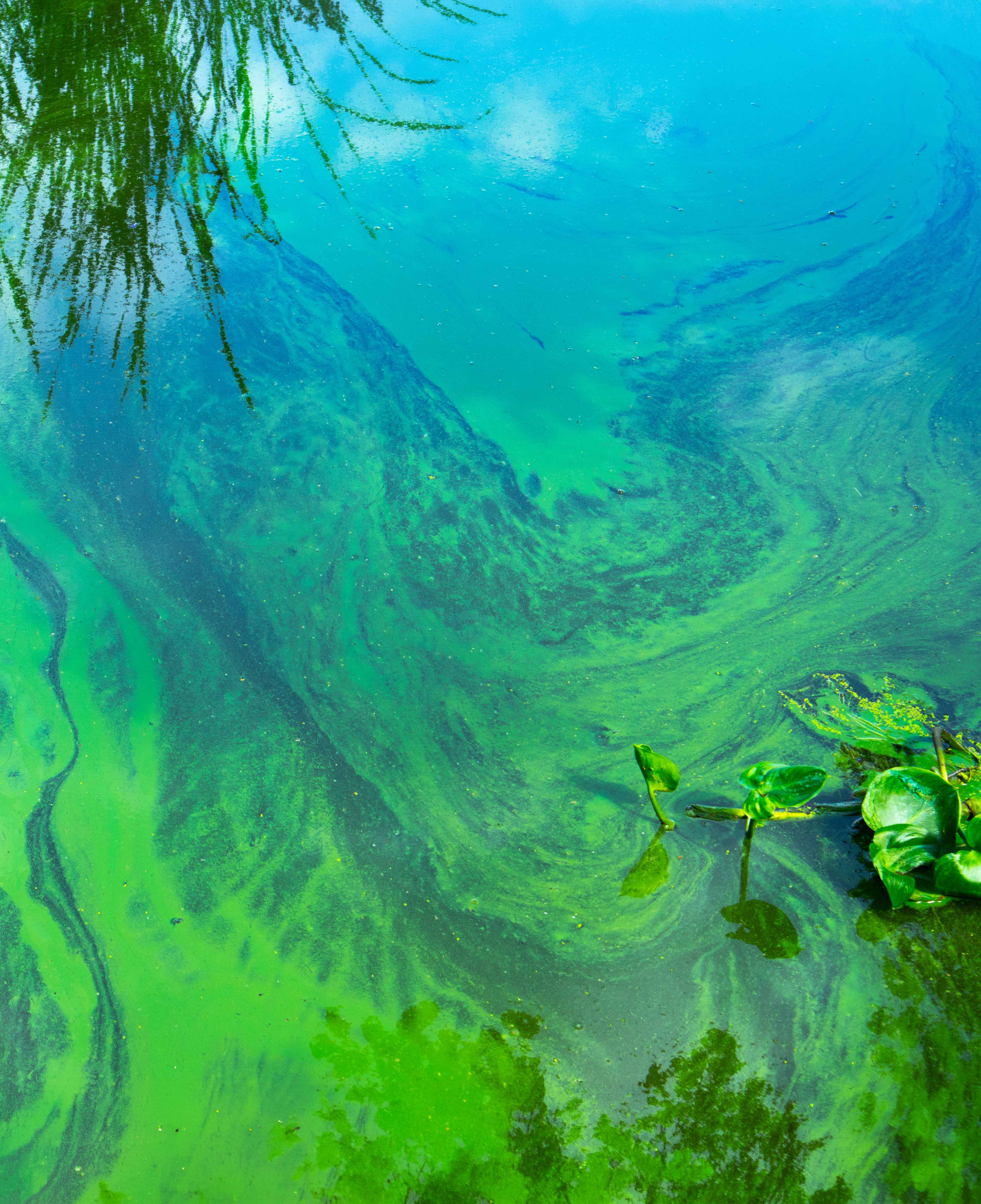
Blue-green algae typically looks like thick, green “pea soup” or spilled turquoise paint floating on the surface of the lake. On calm mornings, you might see localized patches along the shoreline that dissipate as the day goes on. Provincial and health agencies generally only respond when a bloom persists across larger sections of the water.
It is also important not to confuse blue-green algae with other common lake occurrences:
-
Pollen: In early summer, you may see a yellowish film on the water or yellow dust blowing in the wind. This is simply harmless pollen from local forest trees.
-
Green Algae: Blue-green algae looks like a film or scum and has no visible plant structure. If you see long green filaments, stringy strands, or plant-like patches attached to rocks and hard surfaces, this is likely harmless green algae, which does not produce toxins.
How do I prevent exposure?
If you spot a thick green film on the water, the safest approach is to avoid it entirely. Keep yourself, your children, and your pets out of the affected area. Never consume water from an active bloom area, and always follow the latest advisories and guidance issued by local health authorities.
How can I help prevent blooms?
While we cannot control the weather, property owners play a crucial role in limiting the excess nutrients that fuel blooms. You can help protect the lake by:
-
Regularly pumping and maintaining your septic system.
-
Preserving natural vegetation along your shoreline to act as a buffer.
-
Preventing shoreline erosion.
-
Never dumping grass clippings, leaves, or other organic matter into the lake.
-
Supporting the Brandy Lake Association (BLA). By joining the BLA, you help support citizen science projects, monitor upstream land use, and advocate for stronger environmental by-laws and enforcement.
How do I report a bloom?
While reporting is not mandatory, individual property owners can report suspected blooms directly to the Ministry of Environment, Conservation and Parks (MECP) Spills Action Centre. You can file a report online at
Note: The BLA leaves the decision to report up to individual property owners. The Association does not report blooms on behalf of residents and does not take direct action to manage them.
What happens if a bloom is reported?
If a bloom is reported, the local health unit or the Township of Muskoka Lakes will likely post a preliminary public advisory. Agency staff will then visit the lake to observe and sample the water.
The advisory will be updated once initial lab results confirm whether the bloom is actually blue-green algae. A subsequent analysis will determine if toxins are present. Advisories usually remain in place until the end of the season, when the threat has fully passed and the notice is removed.
It is important to understand that neither the local health unit nor the MECP will take action to treat or remove the algae. There are currently no practical management solutions to stop or “clean up” an active blue-green algae bloom; the agencies’ role is strictly to monitor, test, and keep the public informed.