
A Refresher On Blue-green Algae In Brandy Lake
Longtime property owners on Brandy Lake are no strangers to blue-green algae. Algal blooms at the beginning of the 2000s, when the predecessor of the Brandy Lake Association was forming, gave rise to focussed investigations by the Ministry of the Environment. In recent years, there were reported blue-green algae blooms in 2019 and 2020, no significant blooms for three years and then several unreported blooms in 2024 and 2025. But blue-green algae has lived here for a little while longer than that. More than two Billion years in fact.
Like most other life in our ecosystem, we wouldn’t be here if not for blue-green algae. Blue-green algae were among the earliest and most important lifeforms for us because they produced the oxygen in Earth’s otherwise completely toxic atmosphere. They continue to be one of the primary producers of atmospheric oxygen world-wide today.
So why is it such a concern among lake associations and waterfront property owners? We’ve all heard about the increasing threat of annoying and unhealthy blooms, not only in the Muskoka region but across the province and beyond, especially in recent times as more incidents occur amid increasingly erratic weather patterns.
Blue-green algae, or Cyanobacteria, aren’t really algae at all. In a way they are ancestors of all plant life. They are a unique group of bacteria species that evolved the ability to photosynthesize and produce food and oxygen. Bacteria cannot produce oxygen, nor their own food, and they live only by consuming organic matter and oxygen.
All lakes, including Brandy Lake, contain bacteria, plant life including algae (Phytoplankton), blue-green algae (Cyanobacteria) and tiny animals collectively called zooplankton. From there all lakes begin to differ; from the shape of the lake; watershed characteristics, nutrients in the water and sediment, the types of plants and animals that live on the lakebed to the types of animals higher in the food chain like fish, mammals and birds.
While several species of blue-green algae are always present in Brandy Lake, their abundance goes up and down, but occasionally becoming so dense on the lake surface that we easily see it and call it a bloom. A bloom itself isn’t much more than an annoyance, but when so many algal cells die, they may release toxic chemicals that can cause health problems for humans and pets. The key word is “may” because many blooms do not necessarily produce toxins. To wit we’ve never had a toxic bloom in Brandy Lake. But that doesn’t mean we can assume we won’t.
Why do blooms happen?
Its complicated. For years in Muskoka, it was believed that if we track the springtime concentration of Phosphorus in the water column, that would tell us if a bloom would be likely in a given year. But its much more complicated than that. Phosphorus is naturally present in our lake bed and can be released when oxygen is depleted (usually from too much heat and decaying organisms). Calm or warm weather can promote blue-green algae, because they can outcompete other life forms by producing their own oxygen and regulating their buoyancy to remain high in the water column.
KEY FACTS:
- Blue-green algae are a form of bacteria that can produce their own food and oxygen
- Blue-green algae are always present in our lake and are a critical part of Earth’s ecosystems. We would not survive without it.
- Blue-green algae blooms can occur when a number related factors combine, though not all are necessary – low oxygen in the water column, excess nutrients (high concentrations of available Phosphorus), low wind, warm weather.
- Blue-green algae cells can produce toxins when they die in large numbers. If toxins are present, people and pets can get sick through ingestion or skin contact
- Poorly maintained septic systems, lawn fertilizers, shoreline clearing and upstream agricultural runoff can contribute to blue-green algae blooms, in addition to the natural Phosphorus in the lake.
- Wind, rain and cooler temperatures seem to reduce blooms
- There are no practical management options to prevent blue-green algae blooms
- The BLA is not responsible for reporting or managing blue-green blooms, but we are participating in scientific studies to learn more about blooms.
- The Ministry of Environment, Conservation and Parks and the Simcoe-Muskoka Health Unit advise that we should assume a bloom could be toxic until proven not to be through sampling and analysis. It is up to individual property owners to decide whether to call these agencies and to take protective measures like avoiding contact or ingestion.
QUESTION & ANSWER
HOW DO I RECOGNIZE IT ?
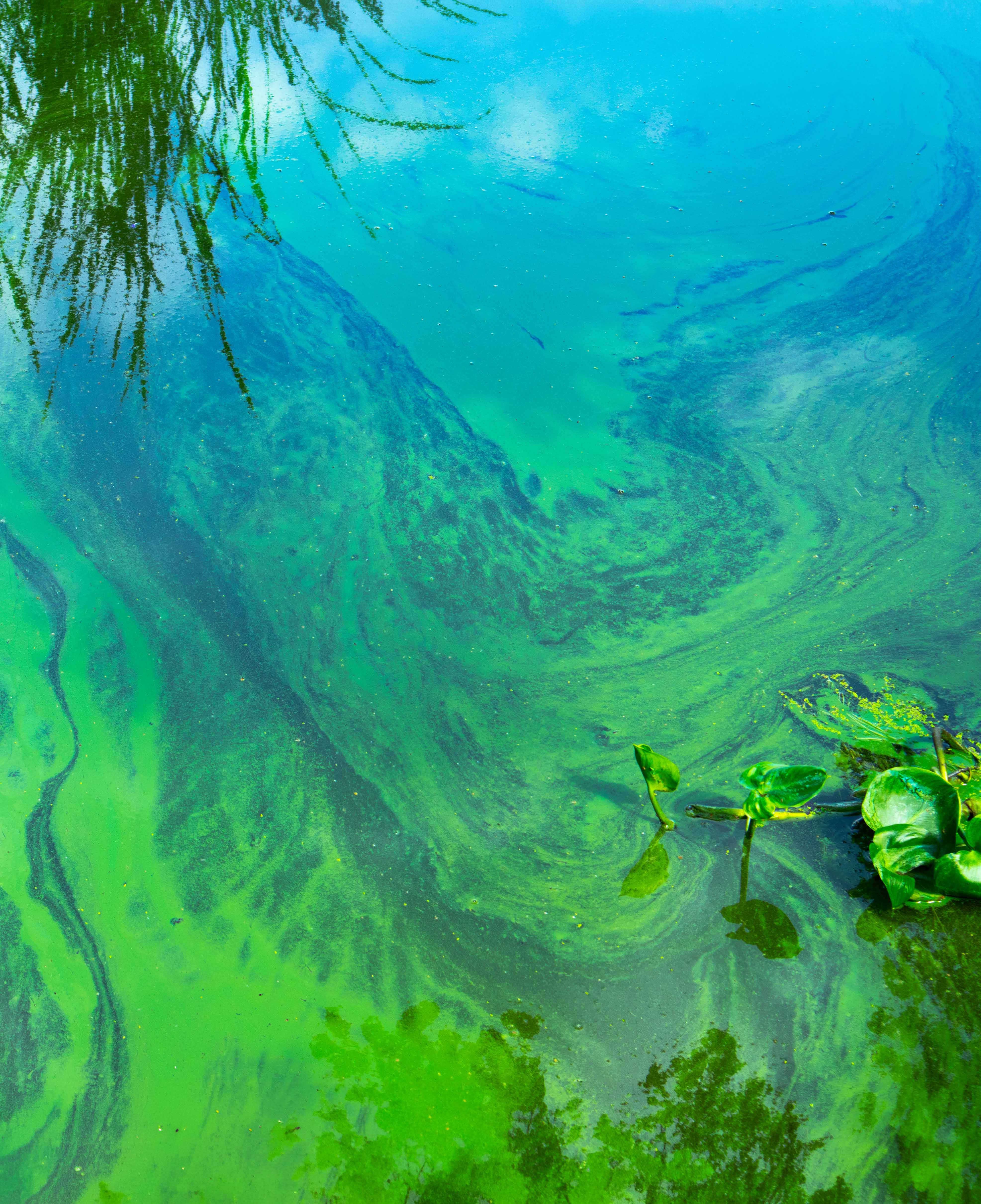
Blue-green algae blooms form a thick green, pea-soup like appearance or turquoise paint on the surface of the lake. Localized patches can occur along shorelines on calm mornings and disappear as the day progresses, but our provincial and health agencies respond when a bloom persists across larger sections of the lake.
Blue-green algae should not be confused with pollen. In early summer, Brandy Lake property owners will often see yellow film in the lake surface or yellow powder blowing in the wind. This is pollen from local forest trees.
Blue-green algae blooms in Brandy Lake also appear as a film on the water surface with no apparent plant-like structure. Long green filaments, strands or patches of algae attached to hard surfaces are more likely green algae which do not produce toxins.
HOW DO I PREVENT EXPOSURE?
Stay out (and keep pets out) of thick green films of algae on the water surface. Follow advisories or guidance from local authorities. Don’t use water from a bloom for consumption.
HOW CAN I HELP PREVENT BLOOMS?
Maintain your septic system
Maintain your shoreline with natural vegetation
Prevent erosion along your shoreline
Do not dump grass clippings or other organic matter into the water
Support the BLA in citizen science projects, monitoring upstream land use practices, advocating for more effective by-laws and enforcement and encouraging property owners to join the BLA.
HOW DO I REPORT A BLOOM?
While there is no requirement to report a bloom, property owners can do so by contacting the Ministry of Environment Conservation and Parks (MECP) SPILLS ACTION CENTRE either online ( https://www.ontario.ca/page/report-pollution-and-spills ) or at 1-800-268-6060 to report a bloom. The BLA does not make recommendations on reporting and does not take action itself.
WHAT HAPPENS IF I REPORT A BLOOM?
Either our local health unit or the Township of Muskoka Lakes will most likely post advisories that there is a potential bloom. Agency staff will observe and sample the water. Advisories will be updated after initial analyses to confirm if the bloom was in fact blue-green algae. A later analysis will confirm if toxin was present, after which advisories will be removed. This usually occurs at the end of the season.
Neither the local health unit nor MECP will take management action other than posting and updating advisories and conducting testing to determine toxicity. There are no management actions or treatments to stop or prevent a blue-green algae bloom.